
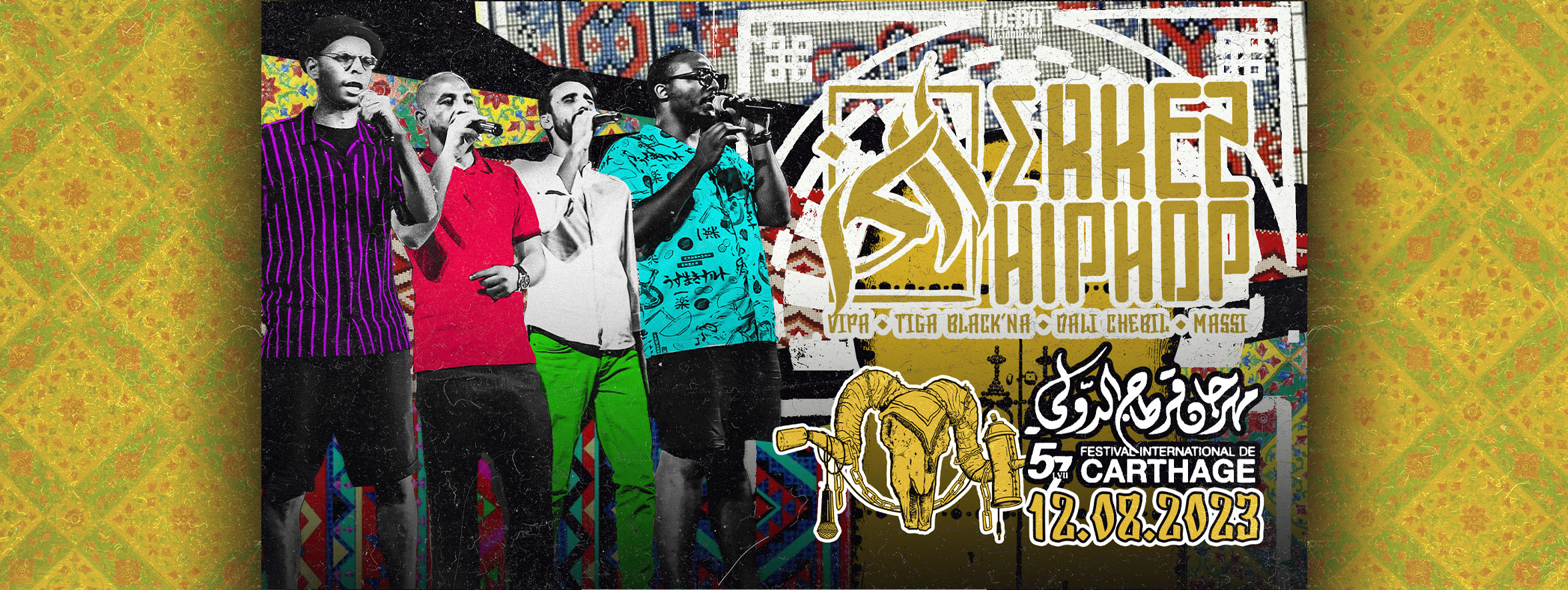
The night when Tunisian hip-hop took over Carthage.
Carthage, 12 August 2023. On the evening of 12 August 2023, the ancient Roman Theatre of Carthage became the stage for one of the defining moments in the history of Erkez HipHop.
As part of the 57th edition of the Festival International de Carthage, one of Tunisia’s most prestigious cultural events, Erkez HipHop presented a specially reworked version of its live show—bringing together rap, mezoued, Tunisian popular music, live instrumentation, choreography, visual storytelling and a large vocal ensemble.
It was a significant moment for a project that had spent years developing at the intersection of Tunisia’s underground hip-hop culture and its popular musical heritage.
And this time, the stage was Carthage.
A historic stage for a new Tunisian sound
The Festival International de Carthage has long been one of the most prestigious stages in Tunisia, the Arab world and the Mediterranean.
The 57th edition of the festival featured an international programme including Ben Harper, Bigflo & Oli, Rag’N’Bone Man, Souad Massi, Yemi Alade, Tiken Jah Fakoly, Latifa and Saber Rebaï. On 12 August, the programme brought together Hatem Lajmi’s Rboukh and Erkez HipHop, creating a distinctly Tunisian evening built around heritage and contemporary expression. The official programme is documented by the Tunisian News Agency (TAP).
For Erkez, the invitation represented something larger than simply another festival appearance.
The project was being given a place on one of the country’s most prestigious cultural stages.
A project born from the Tunisian underground was now performing in the ancient theatre of Carthage.
A special version of Erkez
The Carthage performance was not simply a reproduction of the group’s existing show.
From the beginning, the concert had been announced as a special version, redesigned and rearranged specifically for Carthage.
Erkez worked with arrangers Jihed Khemiri and Makrem Radhoini, who expanded the musical architecture of the project and gave the existing material a new dimension. The pre-concert announcement was covered by Kapitalis and Arabeque.
The show also incorporated a 12-member choir, directed by Mhamoud Turki, adding powerful harmonic and choral elements to the rap and instrumental arrangements.
The visual dimension was equally important.
Zied Litayem and Marwen Rouine worked on the stage direction and scenography, creating a performance conceived not simply as a succession of songs, but as a visual and musical journey.
This was Erkez on a different scale.
More musicians.
More voices.
More visual elements.
More space.
More ambition.
Vipa, Massi and Tiga Black’Na
At the centre of the performance were Erkez’s rappers Vipa, Massi and Tiga Black’Na, alongside singer Dali Chebil.
Together, they embodied the project’s central idea: that Tunisian hip-hop could be something more than a reproduction of an imported musical format.
Erkez’s identity is built around the collision of different Tunisian and international musical languages.
Rap provides the flow, rhythm and directness.
Mezoued provides one of Tunisia’s most recognisable popular sounds.
Bendir and darbuka bring traditional rhythmic foundations.
Jazz, rock, keyboards, electronic production and contemporary arrangements expand the palette.
The result is neither traditional mezoued nor conventional rap.
It is Erkez.
Rap meets mezoued
The central artistic challenge of Erkez HipHop has always been deceptively simple:
Can rap and mezoued belong to the same musical universe?
The project answers that question through the music itself.
The Tunisie.co coverage of the Carthage evening described the night as a successful meeting between tradition and modernity, while the contemporary event presentation described Erkez’s fusion of rap and mezoued as an attempt to break predefined musical models.
This fusion also carries a cultural dimension.
Mezoued has historically occupied an ambiguous position in Tunisia—hugely popular among audiences but often treated as being outside the boundaries of prestigious musical culture.
Putting its sound at the heart of a contemporary hip-hop project on the stage of Carthage carries a certain symbolism.
The sound of the street was no longer outside the gates.
It was on the main stage.
A night of Tunisian music
Erkez was the second part of a deliberately Tunisian evening.
The programme opened with Rboukh, the project by Hatem Lajmi, bringing together more than thirty musicians, singers and performers and drawing heavily on Tunisian popular musical heritage.
Erkez followed, providing a contemporary counterpart to the traditional material. The official Carthage programme confirms the pairing of Rboukh and Erkez HipHop on 12 August 2023.
The contrast was striking.
Rboukh looked toward the roots.
Erkez looked toward what could grow from those roots.
Rather than presenting tradition and modernity as opposing forces, the evening demonstrated that they could exist side by side.
And in Erkez’s case, they could exist inside the same song.
The songs people already knew
The Carthage audience was not discovering Erkez from zero.
By 2023, the project had already built a strong following around songs that had circulated widely online and through television and advertising.
During the concert, the group performed tracks including “La3riba,” “Hwita,” “Mezwed Fsa3,” “5amsa Elli La7gou Bel Jorra,” “Ya Latif” and other pieces from the Erkez repertoire.
Tekiano’s post-concert article documented the performance in detail, noting the audience’s familiarity with the group’s songs and the atmosphere generated inside the theatre.
“La3riba” in particular had become strongly associated with the project after its appearance in a Ramadan advertising campaign, helping Erkez reach audiences far beyond the traditional underground hip-hop scene.
At Carthage, those songs took on another dimension.
The tracks that had circulated through phones, social media and television were now being performed in one of Tunisia’s most historic venues.
A theatre that came alive
The reaction from the audience became one of the defining aspects of the evening.
Post-concert reports described the Carthage amphitheatre as full, with an audience that came prepared to sing, dance and participate. Kapitalis’ follow-up report described the Carthage performance as a success before announcing the group’s next major appearance at El Jem.
The performance was structured in chapters.
Large screens introduced the different sections of the show, while dance sequences and stage movement accompanied the musicians. Tekiano’s report gives a detailed account of this structure.
This transformed the concert from a conventional rap performance into a large-scale stage production.
The audience was not simply watching rappers.
They were watching a combination of:
music + theatre + dance + visual art + traditional instruments + contemporary production.
That multidisciplinary approach is deeply connected to the philosophy of DEBO.
Fifty years of hip-hop—and a Tunisian answer
There was an extraordinary coincidence surrounding the date.
Hip-hop’s origins are conventionally traced to 11 August 1973, when the movement emerged in the Bronx, New York.
Exactly fifty years later, on 12 August 2023, a Tunisian hip-hop project stood on the stage of Carthage.
The coincidence was highlighted in contemporary coverage of the concert, particularly by Tekiano.
Half a century after hip-hop was born in New York, Erkez was asking a very Tunisian question:
What does hip-hop sound like when it grows out of Tunisian streets?
The answer was not an imitation of American hip-hop.
It was rap in Tunisian Arabic.
It was mezoued.
It was bendir and darbuka.
It was local slang, humour and social commentary.
It was traditional musical vocabulary reconstructed through modern production.
From underground to Carthage
Perhaps the most important part of the story is the trajectory.
Erkez HipHop emerged from DEBO, a collective deeply connected to Tunisia’s independent and underground cultural scene.
The project developed through experimentation, live performances and collaboration between rappers, musicians, producers, visual artists and technicians.
Over time, the group moved through different spaces and different audiences.
Clubs.
Cultural centres.
Festivals.
Public events.
International stages.
And eventually:
the Roman Theatre of Carthage.
The official DEBO events archive documents the Carthage performance alongside the group’s other major concerts, placing the show within the broader development of Erkez HipHop.
The Carthage concert represented a form of recognition.
Not because Erkez suddenly became legitimate on that night.
The group had already built its artistic identity.
But because an institution as important as the Festival International de Carthage was now giving that identity a major platform.
The performance in images and video
The concert was also documented by Tunisian media.
Mosaïque FM published a video report from the evening.
The official Festival International de Carthage website also published coverage of the Rboukh and Erkez HipHop evening, describing it as a meeting between heritage and renewal.
More than a concert
Contemporary coverage went further than simply describing the performance as successful.
The concert was repeatedly presented as a confirmation of Erkez’s ability to create a new musical territory between popular Tunisian music and urban culture. Tekiano even framed the performance as a “concert de la consécration.”
And that is ultimately what makes the performance important.
Erkez did not arrive at Carthage trying to prove that Tunisian hip-hop could imitate what had already been done elsewhere.
They arrived with something else.
Something local.
Something hybrid.
Something difficult to classify.
The mezoued was not there as decoration.
The traditional instruments were not there simply to provide an exotic flavour.
They were part of the musical DNA of the project.
The beginning of another chapter
The impact of the Carthage performance was immediate.
Just days later, coverage announced another major Erkez performance at the El Jem World Music Festival, where the group would continue its summer run on 28 August, with Jloud appearing in the first part of the evening. Kapitalis and Tekiano both documented this continuation.
And less than two months later, Erkez would take another important international step with its appearance at L’Olympia Paris for One Night in Tunisia.
Carthage therefore sits at the centre of an important sequence in the group’s history:
Tunisian underground → national festivals → Carthage → El Jem → Paris → international stages.
Erkez at Carthage: a milestone
The 12 August 2023 performance was ultimately more than a successful festival appearance.
It was a milestone.
A project created within Tunisia’s independent hip-hop culture had reached one of the country’s most prestigious stages without abandoning the musical language that made it unique.
On that night, Erkez HipHop demonstrated that Tunisian popular heritage and contemporary urban culture did not have to compete.
They could reinforce each other.
The mezoued could speak through rap.
The bendir could sit beside electronic production.
Tunisian Arabic could fill a Roman theatre.
And hip-hop—fifty years after its birth in New York—could take on another identity entirely.
A Tunisian identity.
On 12 August 2023, under the lights of the ancient theatre, Erkez HipHop did not simply perform in Carthage.
It claimed its place there.